- tax deadline
- T1
- T2
- CRA
- tax filing canada
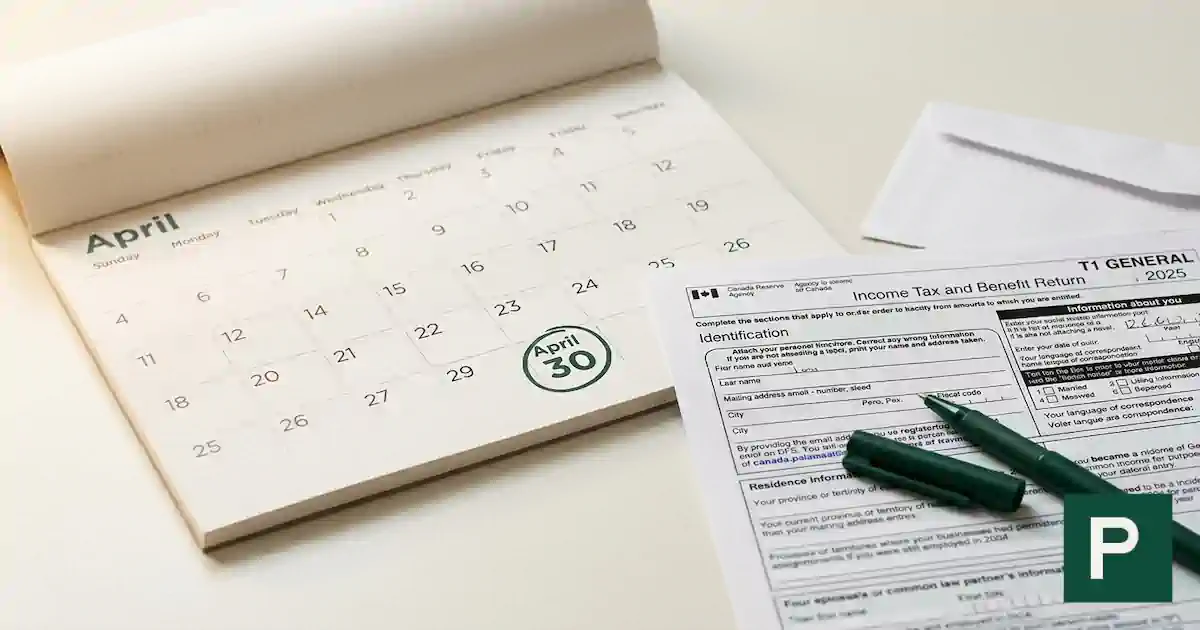
Tax Filing Deadline 2026 Canada: Key Dates You Can’t Miss
Missing a CRA tax deadline triggers interest charges and late-filing penalties that compound quickly. Whether you’re an employee in Toronto, a self-employed contractor, or a corporation, this guide has every key deadline for the 2025 tax year (filed in 2026), with no important details buried in footnotes.
When Does the Canadian Tax Year Start and End?
For individuals, the Canadian tax year runs January 1 to December 31. The 2025 tax year covers income you earned between January 1, 2025 and December 31, 2025.
Corporations use their own fiscal year end, which may or may not align with the calendar year. A December 31 fiscal year-end is common, but many Ontario businesses choose a different year-end for tax planning purposes.
T1 Tax Filing Deadline 2026 for Individuals
Need a Toronto accountant to file your T1 personal tax return? Here are the key dates to know.
Deadline: April 30, 2026
If April 30 falls on a weekend or statutory holiday, the deadline moves to the next business day. For 2026, April 30 is a Thursday, so the deadline stays as April 30, 2026.
This date applies to:
- Employees with T4 income
- Retirees receiving CPP, OAS, and RRSP withdrawals
- Individuals with rental income or investment income
- Anyone who received any taxable income in 2025
If you owe tax, your payment must also arrive by April 30, 2026. Filing on time but paying late means CRA starts charging daily interest (currently the prescribed rate plus 2% per year) from May 1, 2026.
Self-Employed Tax Deadline 2026
Filing deadline: June 15, 2026
Balance owing deadline: April 30, 2026
This is the most common trap for self-employed individuals in Ontario. You have until June 15, 2026 to file your T1 return if you or your spouse had self-employment income in 2025. However, any balance you owe must still be paid by April 30, 2026.
If you pay late - even if you file on time - CRA charges interest from May 1. Use the previous year’s net tax as a benchmark to estimate what you’ll owe, and pay that amount by April 30 to avoid interest while you finalize your return by June 15.
Self-employed individuals also need to file a T2125 (Statement of Business or Professional Activities) with their T1.
Corporate Tax Filing Deadline (T2)
Filing a corporate T2 return on time avoids CRA interest and penalties on your corporation’s balance owing.
Filing deadline: 6 months after fiscal year-end
Payment deadline: 2 or 3 months after fiscal year-end (depending on corporation type)
For a corporation with a December 31, 2025 fiscal year-end:
- T2 return due: June 30, 2026
- Balance owing (small CCPC eligible for small business deduction): March 31, 2026 (3 months after year-end)
- Balance owing (other corporations): February 28, 2026 (2 months after year-end)
Most small Ontario corporations qualify as Canadian-Controlled Private Corporations (CCPCs) and get the 3-month window for payment. Confirm your status with your accountant - the rules around associated corporations and the small business deduction limit can affect this.
HST/GST Filing Deadlines in Ontario
If your Toronto business is registered for HST/GST, your filing deadline depends on your reporting period:
| Reporting period | Due date |
|---|---|
| Annual (Dec 31 year-end) | June 15, 2026 |
| Annual (self-employed individuals) | June 15, 2026 |
| Quarterly (Oct 1 - Dec 31, 2025) | January 31, 2026 |
| Monthly | One month after period end |
Annual filers who owe HST must still pay the net tax owing by April 30, 2026, even though the return is due June 15. This mirrors the T1 self-employed rule.
If your taxable supplies in 2025 exceeded $1.5 million, CRA may require you to move from annual to quarterly or monthly filing for 2026.
RRSP Contribution Deadline
March 2, 2026 (60 days after December 31, 2025)
RRSP contributions made by March 2, 2026 can be deducted on your 2025 T1. The 2025 RRSP contribution limit is 18% of your 2024 earned income, up to a maximum of $32,490, plus any unused room from prior years.
Check your 2024 Notice of Assessment for your exact room, or log into CRA My Account.
What Happens If You Miss the Tax Filing Deadline in Canada?
Late-filing penalty: 5% of the balance owing, plus 1% per complete month the return is late, up to 12 months. If you were penalized for late filing in any of the previous 3 years, the penalty doubles to 10% plus 2% per month.
Interest: CRA charges compound daily interest on unpaid amounts, starting the day after the due date.
Loss of benefits: Filing late can delay or interrupt GST/HST credits, Ontario Trillium Benefit payments, and CCTB/CCB payments for families with children.
Even if you cannot pay your full balance, file on time to avoid the late-filing penalty. The interest on the unpaid amount is almost always cheaper than the penalty for not filing.
Deadline for Tax Losses and Adjustments
T1 adjustment requests (T1-ADJ): You can adjust a prior-year return up to 10 years back. There is no annual deadline for adjustments, but earlier is better - refunds attract no interest.
Loss carrybacks: To carry a 2025 net capital loss or non-capital loss back to a prior year, you must request the adjustment within 3 years of the loss year.
Need Help With Your 2026 Tax Filing? Get a Free Quote from a Toronto Accountant.
Missing CRA deadlines costs real money. Our Toronto accounting team handles T1 personal tax returns, T2 corporate filings, and HST remittances for individuals and businesses across Ontario - all filed on time, all year.
Get a free quote today and take deadlines off your plate.