- CRA meal allowance 2026
- business expenses
- per diem
- T1
- T2
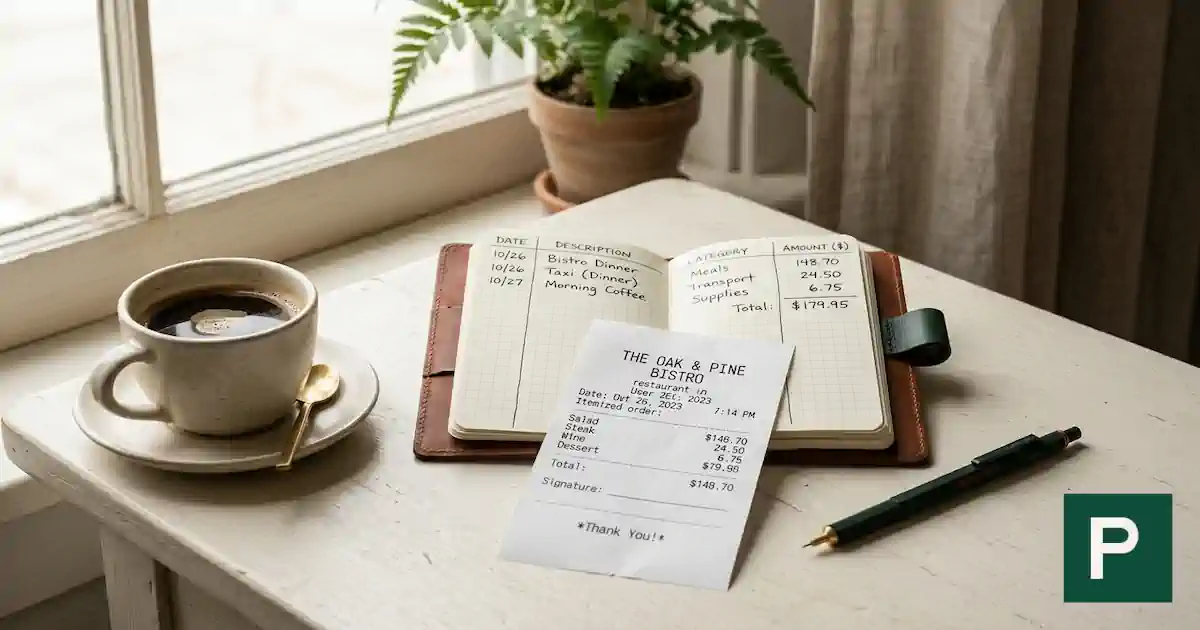
CRA Meal Allowance 2026: Rates and How to Claim Business Expenses
Business meals are one of the most frequently mishandled expense categories in Canadian tax returns. The rules differ depending on whether you’re an employee, a self-employed individual, or a corporation - and they differ again based on whether you use the simplified method or the detailed method. This guide covers the CRA meal allowance rates for 2026 and how to claim them correctly on your T1 or T2.
What Is the CRA Meal Allowance for 2026?
The CRA meal allowance is the per-meal amount that self-employed individuals and employees can use under the simplified method to claim meal expenses without keeping every receipt. For 2026, the CRA simplified method rate is:
- $23 per meal
- $69 per day (maximum for 3 meals)
These amounts apply when you are away from your home and regular place of business for work. You cannot claim three meals per day for a meeting across town - the travel must take you away from your municipality or metropolitan area, or require you to be away from home overnight.
The $23/$69 rate has been in place since 2021. CRA reviews travel rates periodically through its travel directive, but the simplified method amount for personal tax purposes has not changed entering 2026. Monitor the CRA website for any mid-year update.
Simplified Method vs. Detailed Method
Simplified method: Use the flat $23/meal rate. No receipts required per meal. You still need documentation showing the travel dates and business purpose. Maximum claim is $69/day.
Detailed method: Claim actual meal costs, supported by receipts. No per-meal cap under CRA guidelines, though claims must be “reasonable.” Large restaurant bills should reflect the number of people dining, not just one person.
Most individual filers in Toronto use the simplified method because it is faster and audit-resistant. The detailed method is more useful when your actual meal costs consistently exceed $23/meal - for example, client entertainment in downtown Toronto where a business lunch often runs $40-60 per person.
Whichever method you choose, apply it consistently within a trip. You cannot mix simplified and detailed within the same travel period.
CRA Per Diem Rates 2026 for Employees
Employees who are required to travel for work and receive a meal allowance from their employer fall under different rules than self-employed individuals.
Tax-free meal allowances from employers: If your employer pays you a reasonable allowance for meals while travelling for work, that allowance is not included in your income and you do not claim anything on your T1. CRA considers allowances reasonable if they reflect actual meal costs in the location of travel.
If the employer’s allowance is considered unreasonable: The allowance is added to your T4 income in box 40. You can then claim the actual meal expenses (or simplified method) on line 22900 of your T1 using Form T777 (Statement of Employment Expenses).
No allowance from employer: Employees who receive no meal allowance but travel for work can claim meal expenses on T777, subject to employer certification on Form T2200.
Meals for Self-Employed Individuals
Self-employed individuals in Ontario - sole proprietors and partners - report business income and expenses on Form T2125 (Statement of Business or Professional Activities), filed with the T1.
The 50% limitation applies to meals and entertainment: CRA only allows 50% of eligible meal expenses, regardless of method.
Example: You travel from Toronto to Ottawa for a client presentation. Your actual meal costs are $85 for the day. You can claim $85 x 50% = $42.50 as a business expense on T2125.
Using the simplified method for the same trip: $69 x 50% = $34.50 deductible.
In this case the detailed method wins. Run the comparison when your actual costs are meaningfully higher than the simplified rate.
Long-haul truck drivers are an exception: they can deduct 80% of meal expenses (up from 50%) when driving long-haul routes as defined by CRA.
How to Claim Meal Expenses on Your T1 (Self-Employed)
Filing a T1 personal tax return in Toronto? Here is how to handle meal expenses correctly.
- Complete Form T2125 with your total meal expenses for the year in the “Meals and entertainment” line.
- Apply the 50% limit before entering the deductible amount.
- Keep a travel log with dates, destinations, and business purposes for each trip where meals are claimed. CRA requires this on audit.
- Retain receipts for 6 years from the end of the tax year.
How to Claim Meal Expenses on Your T2 (Corporation)
When preparing a corporate T2 return, corporations claim meals and entertainment as a business expense on the T2, subject to the same 50% limitation. The expense reduces net income before calculating the small business deduction or general rate reduction.
Enter the full meal amount on the income statement, then make a 50% add-back on Schedule 1 (Reconciliation of Income for Tax Purposes). Tax software handles this automatically - verify it by checking line 101 of Schedule 1.
Client meals at Ontario restaurants: Deductible at 50% when there is a clear business purpose. Document who attended, the company they represent, and the business topics discussed. A calendar note at the time of the meal is sufficient.
Employee meals at the office (overtime meals): CRA allows a full deduction (not subject to the 50% limit) for meals provided to employees working overtime, if the overtime is temporary and infrequent. A year-end party or occasional after-hours meal qualifies. Daily overtime meal subsidies do not.
CRA Reasonable Meal Allowance: What the CRA Accepts
“Reasonable” in CRA terms means an amount that does not exceed what a person in similar circumstances would normally spend. For 2026, CRA has not published a specific dollar cap for the detailed method. In practice, claims exceeding $60-80 per person for a meal in a major city like Toronto draw scrutiny if the business purpose is thin. Keep records of who attended and what was discussed.
If your corporation provides a meal allowance to employees for overtime work, CRA generally accepts amounts up to three times the simplified method per-meal rate (approximately $69/meal) as reasonable without requiring receipts. Above that, you should document the actual cost.
Common Mistakes Toronto Business Owners Make
Claiming 100% instead of 50%. CRA assessors flag this immediately. Always apply the 50% limit before entering meal expenses on any return.
No travel log. CRA accepts simplified method claims but will ask for a travel log on audit. Without dates, destinations, and business purposes, the claim will be denied.
Personal meals mixed with business. If you eat three meals a day while on a business trip, that doesn’t make all three deductible. The CRA expects you to eat regardless - it is the incremental cost of business travel that is deductible. Generally, claim meals only for periods away from home overnight.
Claiming local client lunches under the travel rules. Local business meals are still 50% deductible as meals and entertainment, but under a different provision than travel meals. The $23/meal simplified rate is for travel, not local dining.
Losing receipts. For the detailed method, CRA requires receipts. Digital scans stored in accounting software are acceptable - photograph them immediately after the meal before they fade.
Need Help Claiming Business Meal Expenses? Get a Free Quote from a Toronto Accountant.
Meal expenses, per diem rates, and the 50% limit create more T1 and T2 errors than almost any other expense category. Our Toronto accounting team reviews your business expenses to maximize legitimate deductions and keep your CRA claims bulletproof.
Get a free quote today and make sure you’re claiming every dollar you’re entitled to.